

Insights
Follow-up & operations4 min readUpdated
How Fast Should You Follow Up With Home-Service Leads? (Speed-to-Lead Guide)
Wondering how fast to follow up with HVAC, roofing, or plumbing leads? See why response time, ownership, and after-hours handling affect booked jobs.
Diagnostic focus:
Explain why speed-to-lead and ownership matter for urgent home-service inquiries.
Helpful?
Save or share this insight with someone diagnosing the same path.
Fast enough that the buyer still remembers why they reached out.
That is the practical answer.
For HVAC, roofing, and plumbing companies, speed-to-lead is not a nice extra. It is part of conversion. If your business responds slowly, inconsistently, or with no clear ownership, good leads go cold before anyone has a real chance to book them.
Why speed matters so much in home services
Home-service inquiries are often:
- urgent
- mobile
- comparison-driven
- submitted outside normal office rhythm
People do not fill out one form and wait forever. They keep looking. They call the next shop. They forget which company was which. They solve the problem another way.
That is why speed-to-lead and ownership matter so much. The lead path is not finished when the form lands. It is finished when someone takes the next real step.
What “fast enough” usually means
There is no single magic number for every business, but there is a useful rule:
The more urgent the job, the faster the follow-up has to be.
That means:
- emergency or same-day categories need near-immediate response
- estimate-driven categories still need fast acknowledgment and a clear next step
- after-hours inquiries need an intentional plan, not a hope that someone sees them in the morning
If your current process depends on one person noticing an email, checking a form inbox, or remembering to call back later, you probably do not have a real speed-to-lead system.
HVAC, roofing, and plumbing leads do not all have the same urgency
Emergency plumbing and no-heat HVAC calls usually need near-immediate response. Roofing estimates may allow slightly more room, but speed still matters because homeowners often keep comparing options. The more urgent the job feels, the less patience the buyer has for a slow call-back.
What usually breaks
For HVAC, roofing, and plumbing teams, the most common breakdowns are:
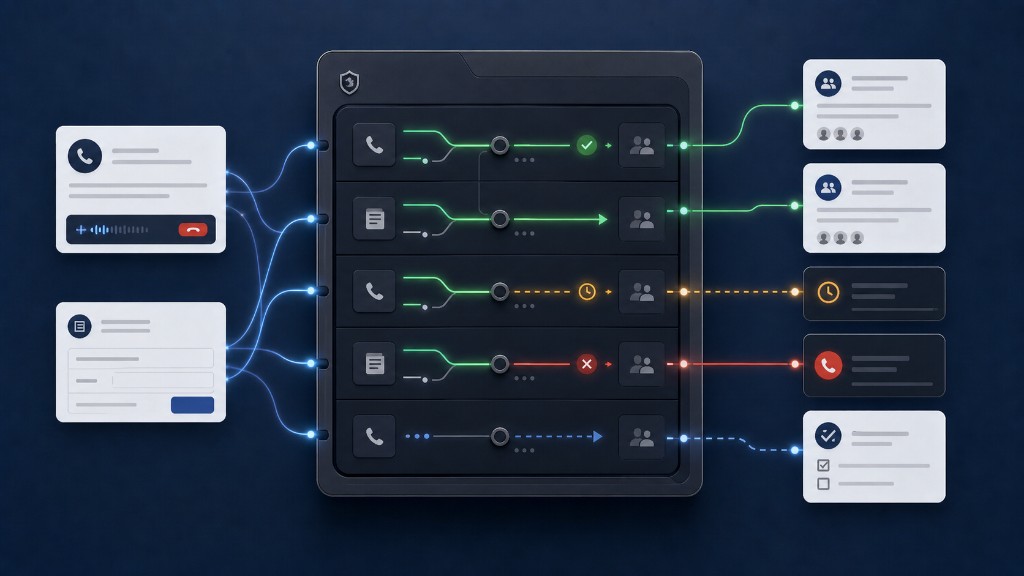
- nobody clearly owns the lead after it comes in
- after-hours forms sit too long
- calls and forms go to different places with no shared view
- the office is busy, so call-backs happen only when someone remembers
- the ad, page, and follow-up path are not connected
If your follow-up process treats every lead the same, urgent jobs and estimate requests can both stall for different reasons.
That is why lead routing and follow-up matters so much. It is not just about software. It is about ownership. If form leads are the main leak, see what happens after the form fill.
What to check first
1. How does the lead enter the business?
If calls, forms, chat, and ads all land in different places, the business will struggle to move quickly.
2. Who owns the next action?
If the answer is "whoever sees it first," that is not ownership.
3. What happens after hours?
If after-hours leads just wait until morning, you should assume some of them are already lost.
4. Can you see where the lead stalled?
If nobody can tell whether the problem was page quality, slow follow-up, no-show handling, or estimate scheduling, the business cannot improve the system.
What good looks like
A healthy home-service lead path usually has:
- one visible owner for the next step
- quick acknowledgement
- fast call-back for urgent jobs
- a clear after-hours path
- enough visibility to know what happened after the form or call
That system also helps every other lane work better:
- ads are easier to judge
- pages are easier to improve
- office bottlenecks are easier to spot
What to do next
If you know leads are coming in but the speed and ownership feel shaky, do not start by rewriting the whole brand or buying more traffic.
Start by looking at the handoff.
A Free Lead Audit helps name whether the real issue is:
- follow-up speed
- unclear ownership
- page quality
- traffic quality
- or the gap between them
You can also review:
Helpful?
Save or share this insight with someone diagnosing the same path.
Found this useful? Share it with someone fixing the same problem.