

Insights
Follow-up & operations2 min readUpdated
What a Home-Service Lead Handoff Process Should Actually Look Like
If your home-service lead handoff is vague, slow, or unowned, good inquiries go cold. Here's what a strong handoff process should actually include.
Diagnostic focus:
Define what "handoff" means for home-service shops so operators can spot vague ownership before buying more traffic.
Helpful?
Save or share this insight with someone diagnosing the same path.
Most home-service companies do not lose leads because nobody cares.
They lose them because the handoff is vague.
A lead comes in. Someone means to call. Someone assumes someone else already did. After-hours inquiries sit. Calendar ownership is fuzzy. By the time anyone acts, the lead is colder than it should be.
That is not a traffic problem. It is a handoff problem.
What a handoff process actually means
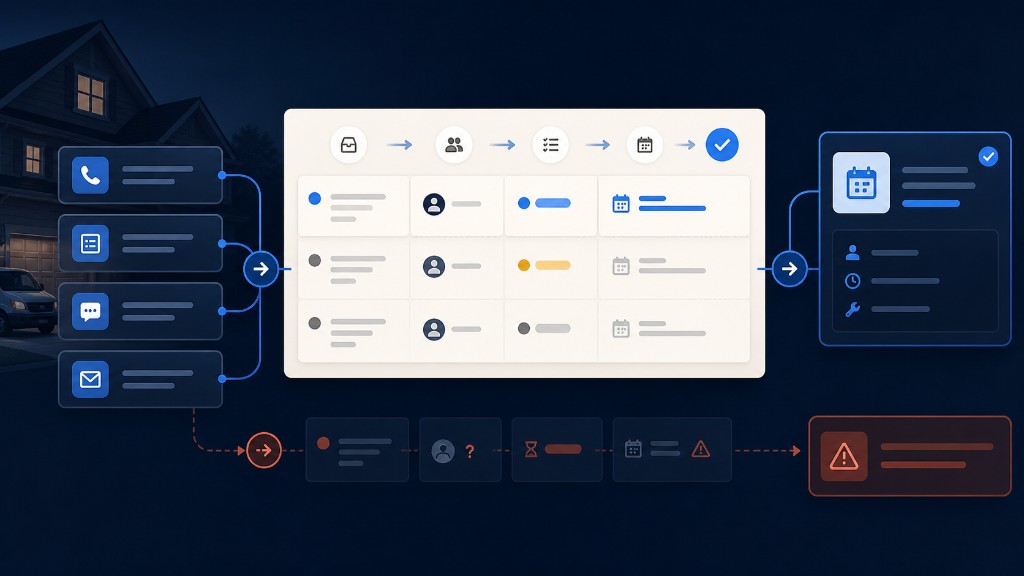
A real lead handoff process answers four questions:
- where does the lead land?
- who owns the next action?
- how fast should that action happen?
- how can someone see whether it happened?
If the answer to any of those is "it depends," the system probably is not strong enough yet.
What usually breaks
The most common failures are:
- forms and calls land in different places
- the office is busy, so nobody acts quickly enough
- after-hours leads wait too long
- there is no visible status change after the inquiry comes in
- nobody can tell where the lead stalled
When the break is specifically after the form submit, read why home-service leads go cold after the form fill.
What good looks like
A strong home-service handoff process usually has:
- one visible entry point or synchronized intake path
- one clear owner for the next step
- a defined response-time expectation
- after-hours handling
- simple status visibility
It does not need to be complicated. It needs to be clear.
That is usually what lead routing and follow-up work is trying to fix: not a pile of tools, but a path your office can run.
What to check first
If you suspect the handoff is the issue, check:
- where calls go
- where forms go
- who owns the next action
- how long the delay usually is
- whether the business can tell booked from unbooked from untouched
For home-service teams, response expectations vary by job type; see how fast you should follow up when timing is the gap.
What to do next
If your lead handoff is vague, do not assume the answer is just more leads, better ads, or a prettier website.
The first fix is often process clarity.
Flowpoint reviews the page, the lead path, and the follow-up system together so the diagnosis reflects booked work, not just raw lead count. See contractor lead follow-up systems for how we scope routing work.
Start with a Free Lead Audit, or walk how we work if you want the sequence before you commit.
Helpful?
Save or share this insight with someone diagnosing the same path.
Found this useful? Share it with someone fixing the same problem.