

Insights
Website conversion3 min readUpdated
Website visitors but not enough calls, orders, or visits? Start here.
Getting website traffic but weak calls, orders, or visits? What local shops, restaurants, service businesses, and venues should check first before buying more traffic.
Diagnostic focus:
Help local business owners diagnose why visitors fail to act (trust, offer clarity, page match, mobile friction, or follow-up) before scaling spend.
Helpful?
Save or share this insight with someone diagnosing the same path.
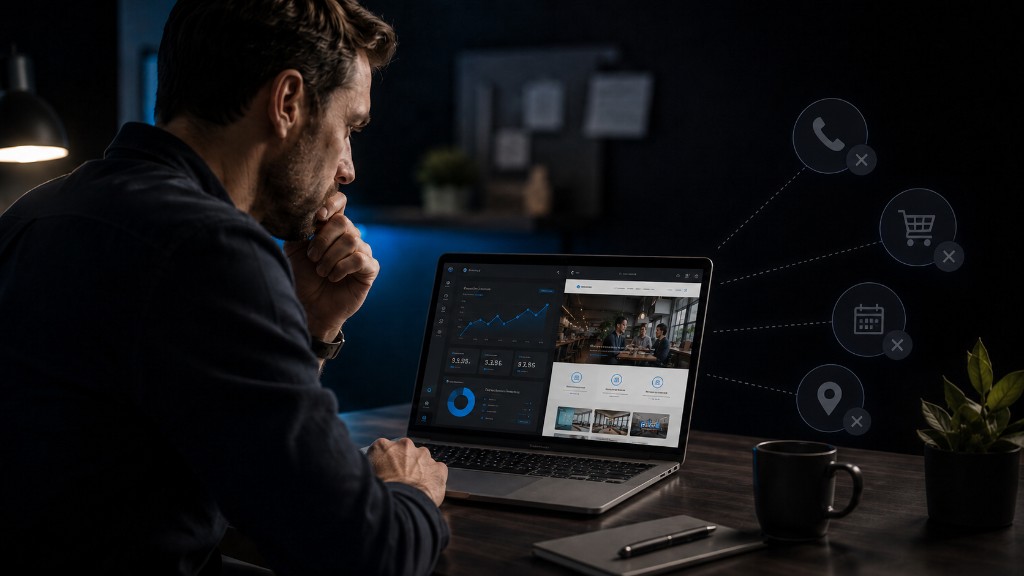
You can see the visits in analytics. The phone is quieter than it should be. Online orders trickle. Foot traffic from the site feels thin. The first instinct is almost always the same: we need more traffic.
Sometimes that is true. Often it is not. A visitor should not have to work this hard. When people land on your site and leave without acting, the issue is usually somewhere between the click and the next step, not a lack of interest in your category.
What is usually happening
Local businesses get high-intent visitors more often than they think. Someone searched for you, clicked an ad, or opened a link from Google. They are comparing options quickly, on a phone, between tasks, with low patience for confusion.
The site fails quietly in a few common ways:
- the offer or service is unclear above the fold
- proof is buried or missing for the decision they are trying to make
- the page does not match what the ad, search result, or map listing promised
- the next step (call, book, order, visit) is hard to find on mobile
- hours, location, or service area information conflicts with your Google profile
- follow-up after a form or call is slow, vague, or nobody owns it
This is where a lot of good businesses quietly lose the lead. The fix is not always a new ad campaign.
What to check first
- Can a new visitor tell what you do and who you serve in the first screen on mobile?
- Is the primary action obvious, call, book, order, directions, or visit?
- Does the page match the ad, search query, or map listing that sent them here?
- Is proof visible early, reviews, photos, credentials, or recent work?
- Do hours, location, and service area match your Google Business Profile?
- After someone inquires, who responds and how fast?
Examples by business type
A restaurant may get menu browsers who never find hours or a reservation path. A gift shop may get product curiosity without location or trust signals. A service company may get emergency searches that land on a generic homepage with no phone button. A venue may get event traffic that hits a page with no date, capacity, or inquiry path.
Same symptom (visits without action), different friction. Sometimes the page is fine, but the next step is fuzzy.
What Flowpoint would look at
We read the path as one system: where traffic comes from, what page it hits, whether proof and offer clarity hold up on mobile, and what happens after someone tries to act. That is website design work when the page is the bottleneck, not a traffic problem dressed up as one.
If you want the same diagnostic lens on your own site, run the free website audit. It names what to fix first. Pricing for builds and retainers stays published if you want to see how ongoing work is scoped after the read.
Helpful?
Save or share this insight with someone diagnosing the same path.
Found this useful? Share it with someone fixing the same problem.